
WeGro
PRODUCT DESIGN · 2021–2022
WEGRO · AGRITECH INVESTMENT PLATFORM
Designing trust into an unfamiliar investment journey.
A product case study about translating agricultural complexity, financial risk, and fragmented operations into a journey urban investors could understand and act on.
- ROLE
- Contract Product Designer
- PERIOD
- Aug 2021 — Jul 2022
- FOCUS
- Mobile product experience
02 / AT A GLANCE
The assignment, without the theatre.
Make an agricultural investment journey understandable before commitment.
A participant who needs clarity across project choice, economics and progress.
High-stakes decisions required evidence, safeguards and legible operations.
03 / CONTEXT
A value chain with consequential work happening beyond the investor’s view.
A participant selects and funds a project; inputs and support reach the field; operations continue; a buyer market closes the loop. The product’s job was to make that multi-party work legible enough to support a decision.
04 / THE INTERFACE PROBLEM
The hard part was not displaying an opportunity. It was making uncertainty readable.
A real agricultural operation has more moving parts than an investment card can show at once.
Risk needed acknowledgement and context—not a superficial promise of safety.
Participants needed a credible way to follow work that happened far from them.
05 / OWNERSHIP + EVIDENCE BOUNDARY
My contribution crossed discovery, definition, design and alignment.
Interviews, field perspective, survey inputs and competitor review informed the early design work.
Turn emerging concerns into a clearer product structure and decision model.
Shape flows, low-fidelity concepts, final UI and the language of status.
Use artifacts to make product decisions discussable across the operating model.
06 / THE TRUST SYSTEM
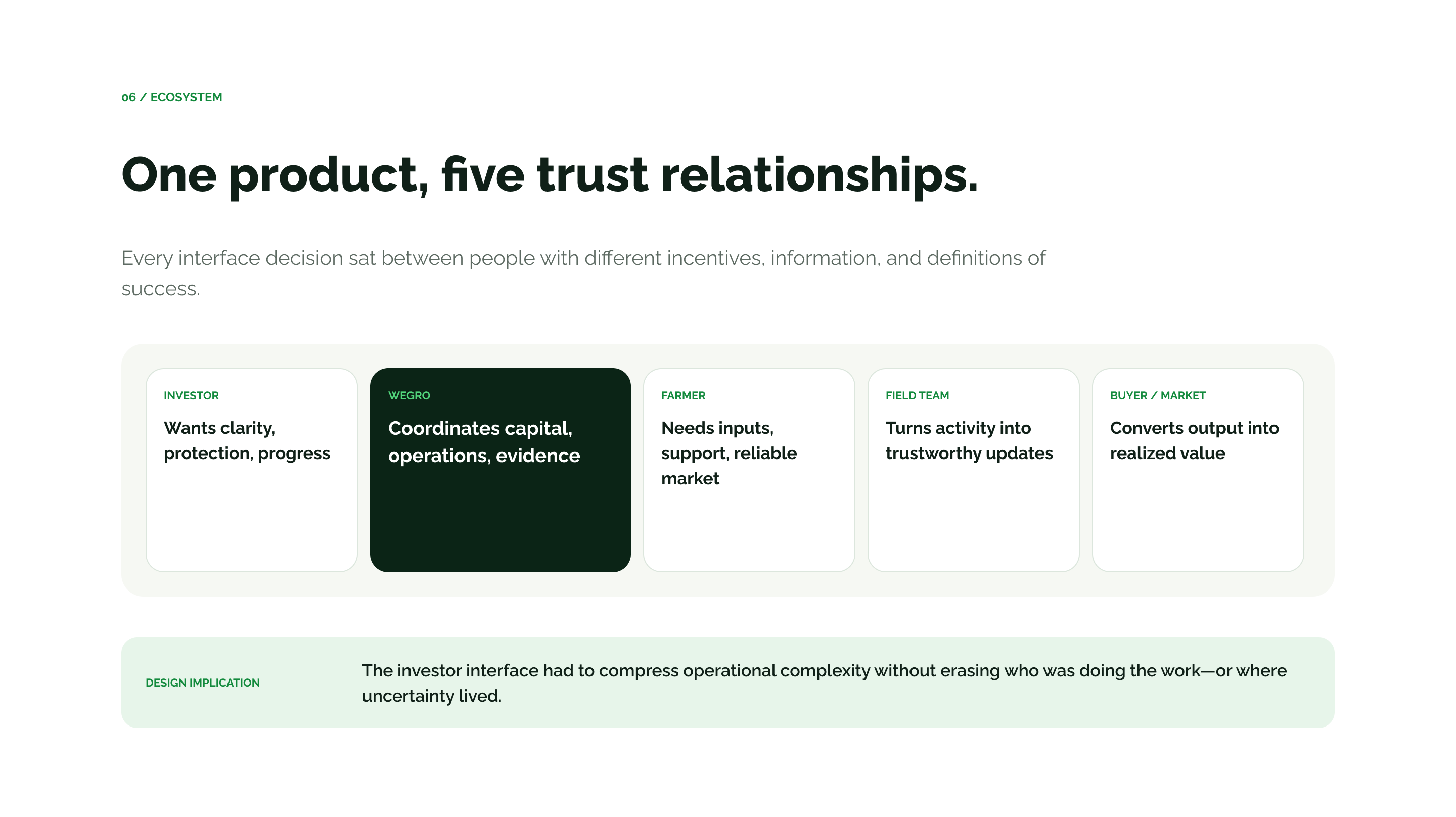
Five relationships had to feel coherent, even when the work was distributed.
Investor, WeGro, farmer, field team and buyer market each held a different part of the operating picture. The design implication was to compress complexity without erasing the work and uncertainty underneath it.
07 / DESIGN THEMES
Available artifacts point to recurring concerns—not quantified findings.
Standardise the project details that make an opportunity comparable.
Make risk, safeguards and the operating process visible before commitment.
Treat milestones, status and updates as part of the investment experience.
08 / PRINCIPLES
Turn investor anxiety into a product responsibility.
- PROJECT AMBIGUITY
- COMPARABLEStructured details, duration, return and funding context.
- FEAR OF LOSS
- SAFEGUARDRisk disclosure, protection, terms and process.
- DISTANCE FROM OPERATIONS
- PROGRESSMilestones, tracking, updates and portfolio visibility.
09 / EXPERIENCE MODEL
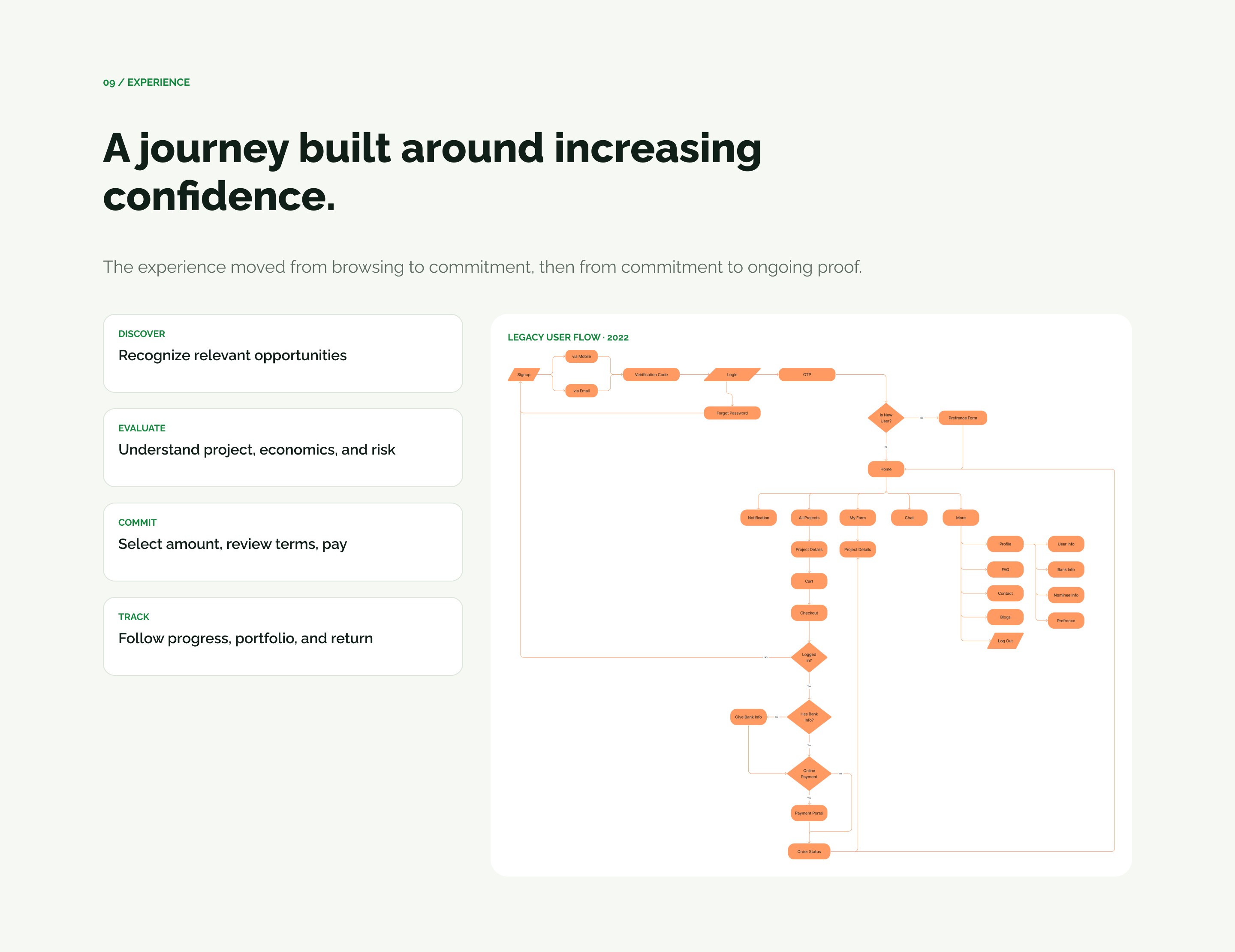
Confidence had to increase before and after the moment of commitment.
Recognise opportunities.
Understand economics and risk.
Choose an amount, review terms and pay.
Follow progress, portfolio and return.
10 / DESIGN TRADE-OFFS
Clarity is not achieved by stripping away the difficult parts.
- 01RETURNS VS RISK
Show the upside without treating uncertainty as an afterthought.
- 02SPEED VS COMPREHENSION
Keep commitment moving while preserving time to understand.
- 03POLISH VS PROOF
Use the interface to make the operating model legible—not merely attractive.
11 / FROM FLOW TO FIDELITY
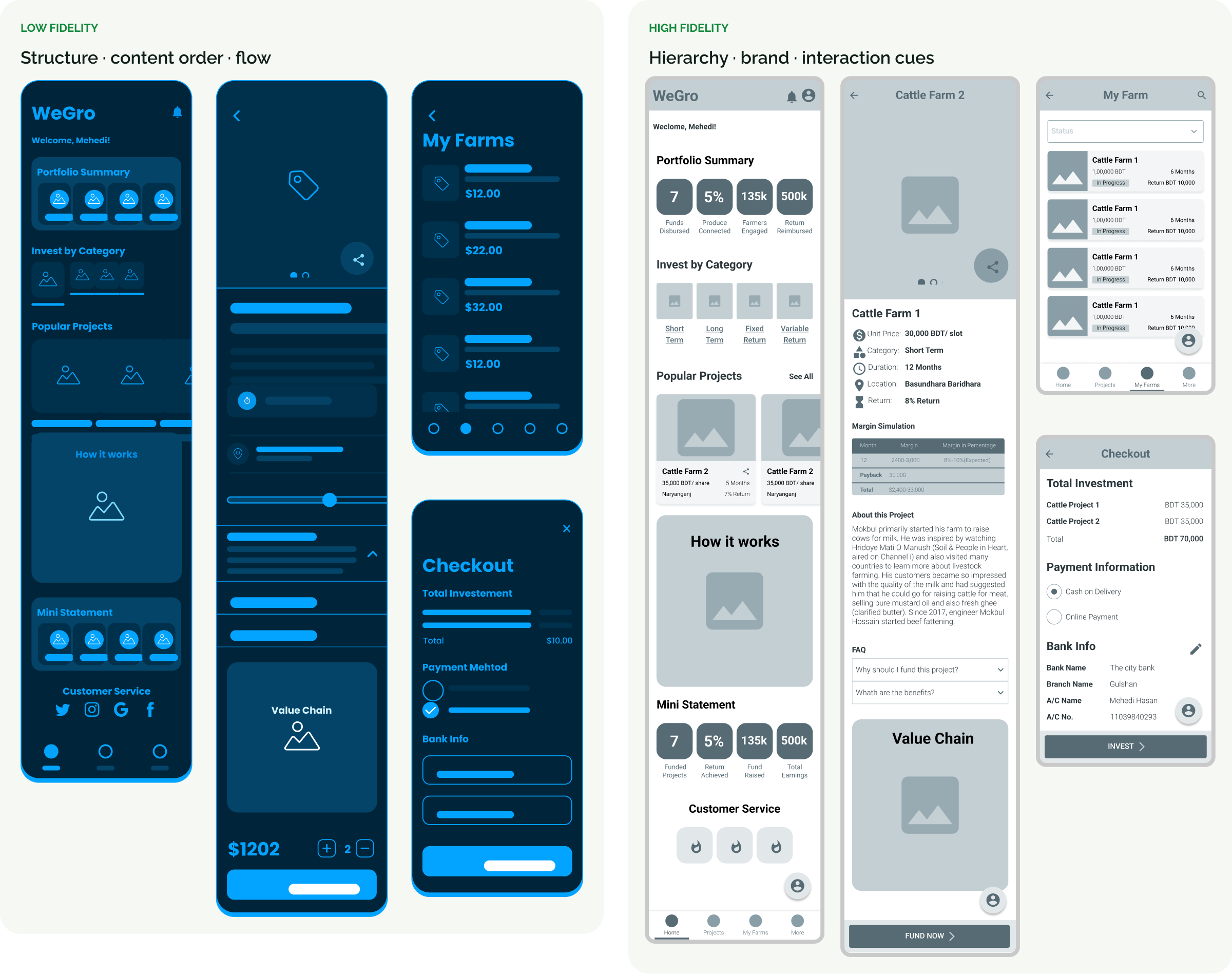
Flow comes before polish.
Low- and high-fidelity artifacts show a structural progression: turn the investment journey into a navigable set of decisions, then establish visual consistency around it.
12 / FINAL EXPERIENCE
Discover → Evaluate → Commit → Track.
The final mobile experience connects opportunity discovery to investment assessment, commitment and ongoing visibility.
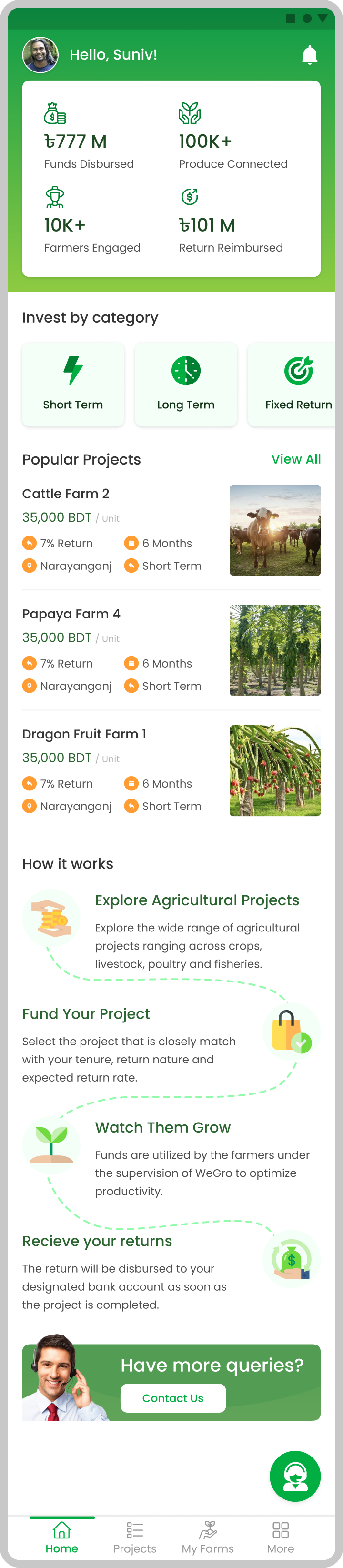
01 / DISCOVER
Understand the opportunity before asking for commitment.
- PORTFOLIO CONTEXT
- Give the investor an immediate sense of activity and scale.
- COMPARABILITY
- Categories and projects make exploration scannable.
- PROCESS CLARITY
- Explain how funding works before asking for money.
01 / DISCOVER Home
02 / EVALUATE
The decision surface.
- ECONOMICS
- Cost, return and duration become understandable before commitment.
- RISK + CONTEXT
- Project information explains what the investment represents.
- CONFIDENCE
- FAQ and value-chain information expose operational detail.
- ACTION
- Commitment comes after the information needed to make the decision.
02 / EVALUATE Project Details

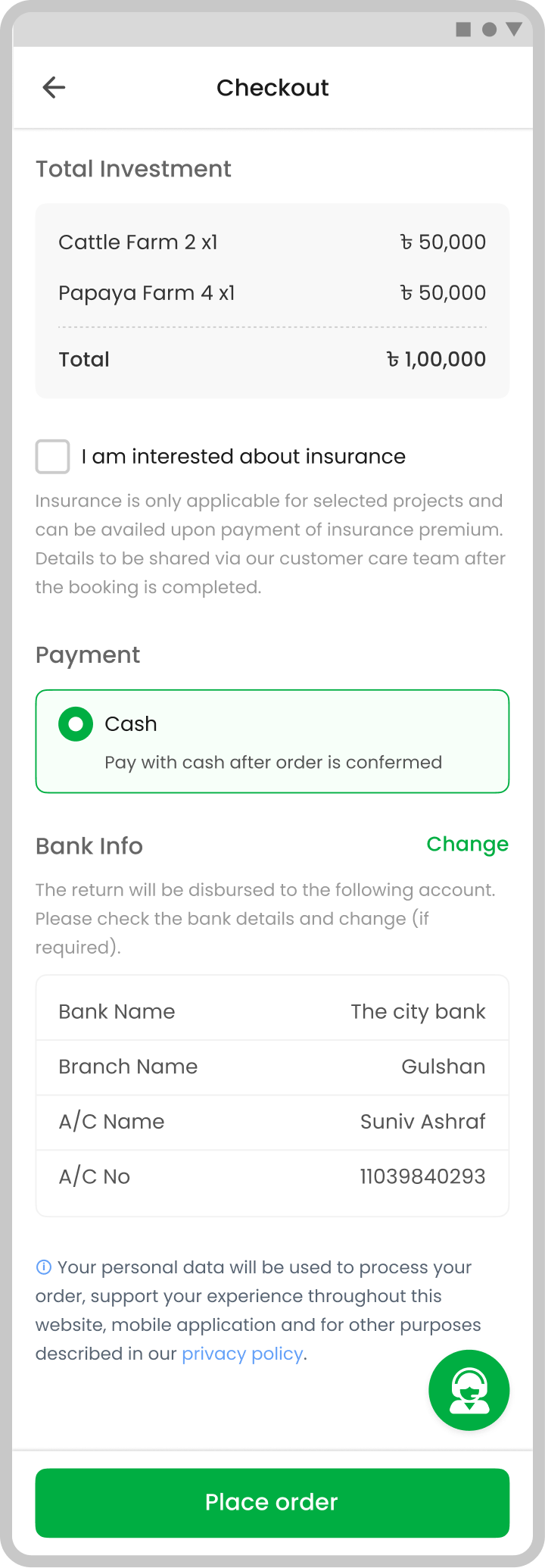
03 / COMMIT
Commit with the terms still visible.
- INVESTMENT SUMMARY
- Reconfirm funded projects and total amount.
- RISK CHOICE
- Keep insurance explicit and optional.
- RETURN DESTINATION
- Connect today’s investment to where future returns will go.
03 / COMMIT Checkout
THE TRANSACTION ISN'T THE END.
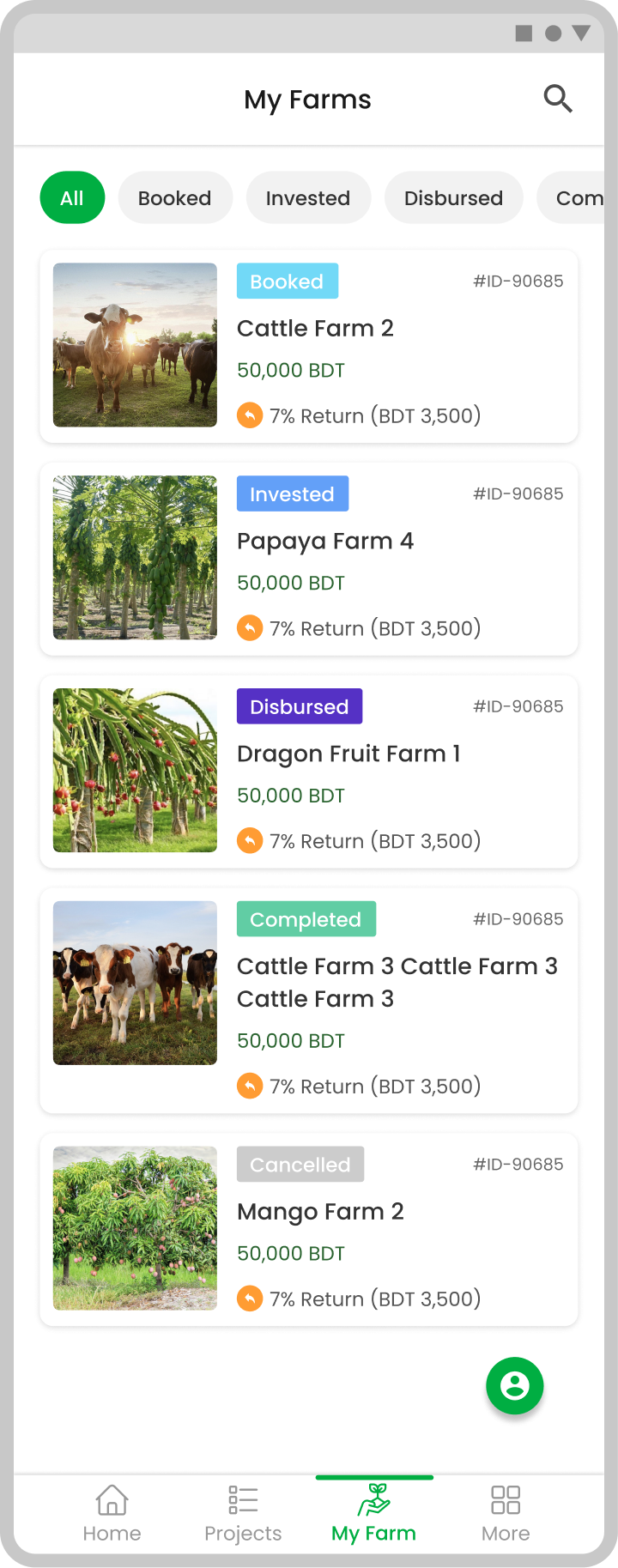
Investment becomes something the user needs to understand and return to.↓04 / TRACK
Investment becomes an ongoing relationship.
- STATUS VISIBILITY
- Booked, invested, disbursed and completed remain distinguishable.
- PORTFOLIO MEMORY
- Previous and active projects stay together.
- ONGOING CONFIDENCE
- Visibility continues after payment.
04 / TRACK My Farms
13 / A SYSTEM THAT SIGNALS TRUST
Consistency made operational information easier to interpret.
Project duration, return, funding, risk and action needed an intelligible order.
Funding active, milestone completed and returned are operational states—not decoration.
Review → choose amount → confirm → pay established a deliberate commitment path.
GREEN FOR PROGRESS · WARM ATTENTION FOR DECISIONS · CLEAR STATES FOR OPERATIONS
14 / VALIDATION
Artifacts show iteration; they do not justify invented test results.
The retained sequence supports a simple reading: flow was established before the final interface was resolved. If this work were revalidated today, the next checks would focus on understanding project economics, risk, checkout confidence and finding progress after the first investment.
15 / BEFORE → AFTER
From browsing an opportunity to managing a relationship with it.
- PROJECT CHOICE
- Opportunity browsing
- Comparable project structure
- RISK
- Implied through brand and return
- Risk, protection and process made discussable
- COMMITMENT
- Transaction endpoint
- Checkout with portfolio tracking
- PROGRESS
- Field activity at a distance
- Milestones and status made visible
16 / COMPANY CONTEXT, NOT DESIGN ATTRIBUTION
Separate the product path I designed from later company scale.
The 2024 impact figures below are WeGro company context, sourced from the WeGro Impact Report 2024. They are not presented as outcomes caused by this design work.
17 / REFLECTION
Trust is designed through evidence.
Risk disclosure is a product feature, not a compliance afterthought.
The work behind agriculture belongs in the interface when it supports a decision.
A case study is stronger when it names what the evidence does and does not support.
18 / NEXT
Make the trust journey measurable.
Future work could instrument the path from discovery to detail, simulation, booking, payment and first progress check; maintain an evidence repository; and establish an operations content model with accessible financial language. These are recommendations, not historical outcomes.